The Distributor Is the Heartbeat of Construction Sales
Key Highlights
- Distributors are the heartbeat of the construction market, especially in small to mid-size projects where influence is most potent.
- Their unique position allows them to see actual product usage, pricing pressures and contractor preferences, giving them a strategic advantage.
- Availability of products, controlled by distributors, is a key factor influencing contractor decisions on smaller projects with tight timelines.
- Manufacturers often overlook the distributor's role as a market hub that interprets field performance and guides product substitutions.
- Proactive engagement and continuous market intelligence enable distributors to anticipate demand and shape construction outcomes more effectively.

Ten years ago in this magazine I wrote an article titled “Securing Your Niche.” The central argument was simple: distributors who want to grow their business cannot simply wait for bid requests from contractors. By the time a project reaches the bidding stage, much of the real work has already been done. Specifications are forming, product decisions are taking shape, and the competitive landscape is already shifting.
The opportunity, I argued then, was for distributors to get involved earlier — during the planning stage of a project — when the conversation about products is still fluid and influence can still shape outcomes.
But over the past decade of working with manufacturers and distributors across the construction marketplace, another conclusion has become increasingly clear: distributors are not just participants in the construction sales process. In many cases, they are the heartbeat of it.
To understand why, we need to step back and look at how the construction economy is actually structured.
The Hidden Structure of the Construction Market
Most industry discussions focus on the largest and most visible projects: stadiums, data centers, manufacturing facilities and other billion-dollar developments. These “megaprojects” dominate headlines and attract enormous attention from manufacturers and engineering firms.
But the reality of the construction economy looks very different when you examine it by project count instead of project value.
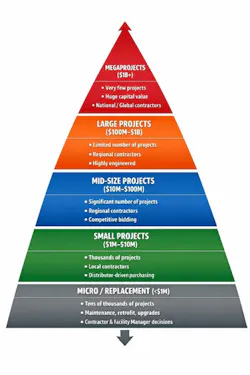
Picture the market as a pyramid (see below). At the top are megaprojects — billion-dollar developments handled by national contractors and heavily engineered by large consulting firms. There are very few of these projects, but they represent enormous capital value.
Below that are large projects in the $100 million to $1 billion range. These involve major regional contractors and still follow a highly structured engineering and specification process.
Move further down and you reach mid-size projects between $10 million and $100 million. These are numerous and competitive, but still largely driven by traditional specification channels.
But the real activity in the construction economy sits below that.
Small projects between $1 million and $10 million — and the even larger universe of replacement, renovation and maintenance work under $1 million — account for thousands of projects every year:
- Schools renovating facilities
- Hospitals upgrading equipment
- Retail spaces being reconfigured
- Warehouses expanding
- Municipal buildings being improved
- Mechanical systems being replaced
These projects rarely make headlines. Yet collectively they represent a massive portion of the construction marketplace. And it is in this lower half of the pyramid where the distributor’s influence becomes most powerful.
How Influence Moves Downstream
In the largest projects, product decisions are typically made through a well-defined hierarchy.
Owners engage engineers and architects. Engineers write specifications. Contractors bid to build the project according to those specifications. Distributors and manufacturers fulfill the requirements that have already been defined. In other words, influence begins upstream. But as projects become smaller, that structure begins to loosen.
Contractors have more flexibility in selecting products – and substituting products. Owners rely more heavily on trusted vendors and their own internal teams. And project timelines move faster, leaving less room for extensive engineering oversight.
In these environments, product decisions are frequently shaped not by specifications written months earlier, but by the realities of installation, availability and contractor experience. And this is where distributors quietly move to the center of the process.
The Distributor Advantage
Distributors possess something that no other participant in the construction ecosystem fully sees. They see what is actually being ordered. Manufacturers know what they produce. Engineers know what they specify. Contractors know what they install.
But distributors sit at the intersection of all three. The distributors see which products move through their warehouses. They hear the questions contractors ask at the counter. They learn which installations go smoothly and which ones create problems. They understand pricing pressures, availability constraints and the subtle preferences that shape contractor behavior.
For example, in the years of conducting market research into the construction marketplace, one word more than any other word appears consistently in the characteristic that trumps all others, including reliability. That characteristic is at the heart of the distributor: Availability.
This aggregated market intelligence combined with availability gives distributors an extraordinary advantage. They understand not just what products are designed for a project, but what products are actually used in the field.
And that insight allows them to influence the market in ways that manufacturers often underestimate.
Availability Is Influence
The reason distributors hold so much power in the lower half of the construction market is simple: they control availability. Contractors working on smaller projects operate under tight timelines. When a product is needed, it must often be delivered immediately or within days. If a product is not stocked locally, it effectively disappears from the contractor’s decision set.
This means that inventory decisions made in a distributor’s warehouse can shape product selection across hundreds of projects. Manufacturers may spend months pursuing specifications on large projects, but thousands of smaller product decisions are happening every day at distributor counters and inside contractor conversations.
The Manufacturer Blind Spot
Many manufacturers continue to focus their sales strategy primarily on engineers and large project specifications. This approach remains important; however, it can overlook the enormous influence distributors exert across the broader construction economy.
Manufacturers sometimes view distributors primarily as logistics partners — organizations that move product from factory to contractor. But in reality distributors often function as market hubs. They aggregate contractor demand. They interpret product performance in the field. They guide substitutions when specifications allow flexibility. And through their relationships with contractors, they shape preferences that ripple through entire regional markets. In short, they influence not just how products are delivered, but how they are chosen.
Returning to the Planning Stage
This brings us back to the argument I made 10 years ago. Distributors who want to grow cannot simply wait for orders. They must become engaged earlier in the project cycle and learn to move across the various channels that shape construction decisions.
But today there is an even broader strategic insight. The distributor’s true advantage lies not only in early involvement in planning stages, but in the continuous flow of market intelligence generated by everyday transactions across thousands of projects. These insights can help distributors do more than respond to demand. Such powerful information allows them to anticipate it. Can you imagine anything more beneficial to sales?
The Heartbeat of the Market
When you step back and look at the construction economy through this lens, a picture emerges that’s quite different than the “usual suspects.” The most visible projects may sit at the top of the pyramid. But the pulse of the market — the constant rhythm of installations, replacements, upgrades and renovations — beats strongest at the bottom. And it is in this vast network of everyday construction activity that distributors often hold the most influence.
They see the market in motion. They connect contractors, manufacturers and products.And whether the industry fully recognizes it or not, they remain the heartbeat of construction sales. The question is: what are they prepared to do about it?
THE CONSTRUCTION PYRAMID EXPLAINED
When most people think about the construction market, they picture the largest projects — stadiums, data centers, manufacturing plants and other billion-dollar developments. These projects dominate headlines and often receive the most attention from manufacturers and engineering firms.
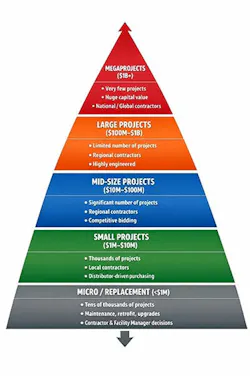
But those projects represent only the very top of the construction economy. A more accurate way to understand the market is to visualize it as a pyramid. At the top sit megaprojects valued at $1 billion or more. These projects are few in number but represent enormous capital investment and typically involve large national contractors and heavily engineered specifications.
Below them are large projects between $100 million and $1 billion, followed by mid-size projects between $10 million and $100 million. These projects are more numerous but still tend to follow traditional engineering and specification processes.
The real volume of construction activity, however, lies in the lower half of the pyramid. Small projects between $1 million and $10 million — along with the even larger universe of renovation, replacement and maintenance work under $1 million — account for thousands of projects every year. Schools modernize facilities, hospitals upgrade systems, retail spaces evolve, warehouses expand and mechanical systems are replaced.
While these projects rarely receive the same attention as megaprojects, collectively they form the operational backbone of the construction economy.
And because decisions on these projects often depend on contractor experience, product availability and practical installation knowledge, distributors frequently play a much larger role in shaping product selection than many manufacturers realize.
3 STRATEGIC MOVES DISTRIBUTORS SHOULD MAKE TODAY
Distributors occupy a unique position in the construction economy. Because they sit at the intersection of contractors, manufacturers and projects, they possess insights that others simply don’t see. The challenge is turning that insight into strategic advantage. Here are three practical ways to begin.
#1. Turn Transaction Data Into Market Intelligence
Every order that moves through a distributor’s system contains information about the market.
- Which products are contractors asking for?
- Which manufacturers are gaining traction?
- Where are replacement cycles beginning to appear?
Most distributors view this information simply as sales history. In reality, it's market intelligence. By analyzing purchasing patterns across customers and product categories, distributors can identify trends long before they become visible elsewhere in the industry. That knowledge can help them advise contractors, inform manufacturers and even influence specifications earlier in the project cycle. In short, what looks like routine sales data is often the best view available of what is actually happening in the field. It’s called product intelligence, and it’s worth its weight in gold.
#2. Expand Relationships Beyond the Contractor Channel
Contractors will always be the distributor’s core customer. But distributors who want to increase their influence should broaden their relationships with other participants in the construction ecosystem. Architects, engineers, facility managers and owners all shape product decisions long before installation begins. Distributors who learn to communicate comfortably with these groups can move from simply supplying products to helping shape the conversations that determine which products are used.
This doesn’t mean abandoning the contractor channel. It means building bridges to adjacent channels so that the distributor’s knowledge of products and installations becomes part of the planning process. You can do this through webinars, presentations at the owner level, ongoing newsletters that contain insights into the movement of products.
#3. Become the Local Authority on What Works
Manufacturers design products and engineers specify them. But distributors often have the clearest view of what actually performs in the field.
- Which installations go smoothly?
- Which products create service calls?
- Which solutions contractors trust?
Distributors who organize and share this knowledge position themselves as trusted advisors rather than order processors. Contractors rely on them for guidance, manufacturers rely on them for feedback, and engineers often value their practical insight into installation and maintenance.
Over time this role transforms the distributor from a product supplier into a market authority — and that authority is where real influence begins.
About the Author

Jim Nowakowski
President, Interline Creative Group
Jim Nowakowski is president of Interline Creative Group, Palatine, IL. He has written for Electrical Wholesaling for many years on marketing and management topics, most recently on branding, harnessing social media and search engine optimization.
You can reach him at jim.interlinegroup.com or 847-358-4848.