
When Electrical Wholesaling’s editors get to work on their annual update of the Electrical Pyramid (see below), it gives us a chance to analyze the competitive landscape in the electrical market and see if any new online or brick-and-mortar competitors are taking an interest in the electrical business.
While EW’s 2026 Electrical Pyramid is intended to be a snapshot of the electrical market as a whole, it can also be used as a tool to analyze the channels of distribution in your geographic market of choice. You can also use it to look at other channels, such as online merchants, product specialists, other distributors from other industries that also sell electrical products. So, get out your magic markers and whiteboards and start drawing your own electrical pyramids.
One other key thought to remember before you dig into the valuable exercise of building your own electrical pyramid: Remember that there really isn’t any right or wrong combination of channels of distribution. EW’s Electrical Pyramid is in some ways more like a kaleidoscope than a snapshot of the electrical channel, in that the bricks in it shift on a product-by-product or market-by-market basis.
For instance, a manufacturer that wants to grow in the New York-New Jersey metro area may have entirely different Electrical Pyramids for New York City, New Jersey and Long Island because the channels of distribution and local buying influences can be very different. And the bricks in the pyramid that a local electrical distributor will build to analyze his competition for a slice of that same market will look different from that manufacturer’s pyramid.
The Electrical Pyramid is going to be much more valuable if you build your own and customize it to your own unique market needs. But like lots of things, the devil is in the details. It’s a fun exercise, so don’t be afraid. Here’s how to get started.
Schedule at least a half-day
Invite your management team and best strategic thinkers to this session. If you can do it off-site in a conference room, all the better, but if time or budget don’t allow it, find a quiet room in your building where you can spread things out a bit.
Bring the right equipment
If you are leading the discussion and are a white-board type of guy or gal, you will have fun with this assignment. Bring ample erasable markers — you will be building an Electrical Pyramid brick-by-brick and will be thinking on the fly. Or, if you aren’t into white boards, get hold of a large roll of newsprint from an art supply or craft store and bring along a handful of markers. Other resources include laptops, fast internet access, copies of this article; and sticky notes. The analysis in this article will provide a high-altitude overview of the various channels (bricks) in each tier of the pyramid. Your job in this exercise is to bring this analysis down to ground level for the market area under discussion, and identify all the key players in it.
If you want to get creative and make it a fun hands-on exercise, you may even want to try bringing along some large wooden building blocks, and Legos or Duplo bricks. Assign the person in the room with the most artistic talent with the job of inscribing each brick with the channel of distribution under discussion.
Assign one person to be the “scribe”
If you are going with the building block idea, you have your man or woman. But make sure you have someone who is copying down all the ideas sure to be flying around the room.
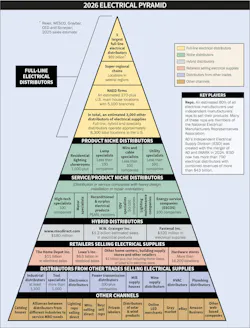
Build your pyramid level-by-level, starting with full-line distributors Here’s where you will need a copy of Electrical Wholesaling’s Electrical Pyramid illustration (Available to download through the link below the illustration). You may find it easiest to start at the top with full-line electrical distributors and work your way down through the seven tiers shown in the illustration.
List all of your competitors
If you are a distributor, go around the room and start listing all competitors. Group them by national chain, regional chain or local independent. If you are an electrical manufacturer or independent manufacturers’ rep, do the same thing, but you may want to group them by the amount of business you do, don’t do or want to do with them. Depending on the type of analysis you are doing, you may also want to pencil in which buying/marketing groups the distributors are in, if any.
And don’t forget to factor in the huge role independent reps play in any local market. Depending on your position in the market (distributor, rep, manufacturer, consultant, etc.) you may or may not want to list and profile all of the independent manufacturers’ reps in the market, and possibly the factory-employed field salespeople who cover the market as well.
Build company profiles for key competitors
Okay, now the hard work starts. Compiling a list of distributors (or reps) in your market may unearth a few surprises and provide some valuable information. But to make this information really work for you, sketch out a profile for each of these companies and drill down to their strengths and weaknesses.
The basic company profile should include key management personnel; estimated sales volume; market share; and primary market focus. You also need to get answers from your assembled team to questions such as:
· What value-added services does this company provide that we currently don’t offer?
· On the flip side, which services do we offer where we have a clear advantage?
· Who are their biggest accounts?
· With which customers are they most vulnerable?
· Have they developed any virtual sales or digital market strategies that we can borrow?
You may find that creating an Electrical Pyramid leads to the creation of a “customer pyramid,” where you analyze your market’s key accounts by size, type of company, market focus, the level of service required and how they buy product. Remember psychologist Abraham Maslow’s “hierarchy of needs” pyramid from that Psychology 101 class, which illustrated our basic need for food, water, shelter, companionship, respect, etc.? You could draw up a customer’s “hierarchy of needs,” where you illustrate the importance of price, delivery, education, return policy, etc.
With a copy of Electrical Wholesaling’s 2026 Electrical Pyramid in hand, spend some time analyzing profile of the types of companies selling electrical supplies:
Full-line distributors; product niche distributors; Service/product niche distributors; hybrid distributors; Retailers selling electrical supplies; Distributors from other trades selling electrical supplies; and other channels.
Full-line distributors
Five national chains. WESCO, Sonepar, Graybar, CED and Rexel account for an estimated 46% of the $154.6 million in sales flowing through electrical distributors, a big chunk of the 76% of sales accounted for by this year’s Electrical Wholesaling Top 100.
Independent distributors. With all the M&A activity, it’s getting tougher than ever to get a realistic count on how many full-line distributors are operating in North America. According to data in the EW Top 100, the full-liners and product distributors in that ranking run 5,848 branches, and if you include the hybrid distributors W.W. Grainger, Lake Forest, IL; Ferguson Enterprises, Newport News, VA; and Fastenal, Winona, MN;, that number rises to 10,020 branches.
Product specialists
Now move down to the next tier of the Electrical Pyramid. Go around the room and get people to brainstorm about all of the niche distributors in your market area that focus on a specific product category. The biggest product specialists typically include residential lighting, lamps, wire and cable and utility products. Others include fuses, voice-data-video (VDV) products and utility supplies. You may be surprised by how many product specialists in your market area compete with you on a few product lines. Depending on how in-depth you want to go with your analysis, you may or may not want to develop company profiles for each of these product specialists.
Service or specialty product niche distributors
Find out what ESCOs and lighting maintenance companies are doing in your market. Service/product niche distributors have a heavy emphasis on design, installation or repair. Although they sell electrical supplies, product sales may not be their primary function. These companies focus on providing a complete service solution to their customers.
Pay special attention to ESCOs, which provide the most sophisticated package of design, financing, technical assistance, audit and, in some cases, installation services in the energy market. The sale of electrical products is a relatively small piece of the overall package of products and services that ESCOs provide. ESCOs occasionally need for distributors to provide local warehousing support and logistics for their lighting retrofit projects.
The National Association of Energy Service Companies (NAESCO), Washington, DC, offers some good insight into the world of ESCOs at www.naesco.org.
You should also pencil in lighting-maintenance companies into this tier of your pyramid. These companies, which typically have contracts for the maintenance and retrofit of lighting systems in stores, parking lots and other retail or commercial facilities and are often NALMCO members, are emerging as skilled players in the energy game, as discussed earlier.
Hybrid distributors
Don’t overlook Grainger and Fastenal. Grainger and Fastenal are tough to categorize because they don’t carry a full line of electrical products. But they are competitors to full-line distributors because of their intense focus on the industrial MRO and facility maintenance markets, rock-solid balance sheets and progressive internal operations. Electrical products, lighting and motors account for 8.5% of Grainger’s U.S. sales.\But there’s plenty of other products for the factory floor or construction site that you can find on www.grainger.com or in its branches, and in total Grainger sells more than $1.2 billion in electrical supplies and related products of interest to electrical. Add in Grainger’s sheer size, willingness to invest in its e-business capabilities, distribution network and branch infrastructure and you can see why the company is a formidable competitor. If you have a Grainger branch in your neighborhood, add a brick to your pyramid for them.
By some measures, Fastenal may be a peripheral player in the electrical market. But with almost 5% of its $8.2 billion in sales ($320.5 million) in electrical products and 1,499 branches in North America, you need to keep an eye on them. Add another brick to your pyramid for them.
Another hybrid distributor to watch for is MSC Industrial Supply, Melville, NY, with $3.8 billion in MRO supply sales through 36 locations in the United States. The company has approximately 2.4 million SKUs in its e-commerce channels and if you estimate that MSC has the same percentage in electrical products as Grainger and Fastenal, its electrical sales are about $180.5 million.
Big-box stores
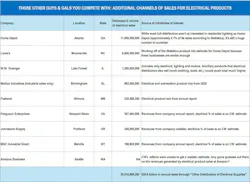
Home Depot does an estimated $11.1 billion in electrical and lighting sales and Lowe’s does an estimated $6.5 billion in these products. While electrical supplies account for roughly 8.2% of a home center’s total revenues, over 5.1% of that figure is in lighting, which typically is largely residential and may not be of as much interest. According to www.tikr.com, the company operates about 2,300 stores
Roughly 50% of Home Depot’s $164.7 billion in 2025 revenues come from professional contractors. The company offers its Pro Xtra app to professionals so they can track in-store and online purchase and savings through the Perks program.
The company is also intent on growing in the MRO marketplace and in 2020 acquired HD Supply, a national distributor of MRO products to multi-family, hospitality, healthcare and government housing facilities, among others. The company’s MRO business sells products primarily through a professional sales force, its e-commerce platforms and print catalogs.
Lowe's has historically had a bigger focus on do-it-yourselfers than contractors, and it gets 20% to 25% of its $86.3 billion in annual revenues from contractors. However, over the last few years, Lowe’s has invested in its Pro operation to go after the contractor segments. In 2024, the company rolled out several new features in its stores for professional customers, including dedicated checkout stations for pros, and the Pro Zone for grab-and-go convenience. The company’s MVPS Business Tools offer online quoting, a volume savings program, quick re-ordering for frequently purchased items and order tracking. The company operates around 1,700 stores, according to www.tikr.com.
Hardware stores & co-ops
There are 14,209 hardware stores in the United States, according to a research report at www.ibisworld.com. Many of these independently owned and operated stores are members of one of the hardware industry’s three largest buying cooperatives — Ace Hardware, True Value and Do It Best. If you take the total combined sales data of each of these co-ops and use that 7.5% electrical/lighting multiplier from home centers, members sell an estimated $1.1 billion in electrical supplies. Ace Hardware, with 5,250-plus stores and $10 billion in 2025 total revenues and an estimated $750 million in electrical/lighting sales, the largest, followed by Do It Best, which specializes in hardware, lumber and building supplies. Do It Best tallied $4.9 billion in 2025 sales and an estimated $366 million in electrical supplies.
Distributors from other trades selling electrical supplies
That distributor down the street may be a competitor. When you have at least 1,000 industrial distributors, 1,000 tool specialist distributors, perhaps 100 specialists in power transmission products in the United States, you know some electrical sales are flowing through these often-overlooked channels. If you have any of these types of distributors in your market, as well as distributors of electronics components, HVAC equipment, plumbing supplies or other specialty distributors, they may be worth further study to see what kinds of electrical products they might be stocking.
It makes sense to get to know the distributors from other trades in your local market area. In a sense, you are in the same business but are just shipping different stuff in the boxes. Find some non-competing distributors from other trades and compare best practices in sales, warehousing, delivery, e-business and operations. You may also want to consider joining the National Association of Wholesaler-Distributors (NAW), Washington, DC (www.naw.org), which provides some terrific venues for networking with distributors from other trades and an insider’s perspective on legislative issues of interest to distribution firms.
Other channels
Always changing but always growing. Any single brick in this level of the EW Electrical Pyramid may or may not account for a ton of electrical sales in your market. This level of the Pyramid may be toughest to track because it’s where the new and potentially competing channels of distribution first start out.
Do you have any reps in the spec-grade lighting niche selling direct? Pencil them in. And if solar is growing in your market area, find out who is selling the photovoltaic (PV) equipment. It might be a small PV contractor who is also a dealer for a limited number of lines.
Another hotly debated sales channel is the manufacturers selling direct. Outside of providing large quantities of wire and cable for massive projects in the utility market; gigantic turnkey switchgear or automation projects; spec-grade lighting packages; and now LED lighting solutions, this historically hasn’t been a widespread issue in the mainstream electrical wholesaling industry.
Online Merchants
Depending on your market position, these bricks in the pyramid may be changing the fastest. The most obvious bricks here include www.amazonbusiness.com, www.ebay.com and online LED merchants. While Amazon Business doesn’t break out sales by individual product category, the company says its total 2025 revenues were $60 billion.
Summary
While the electrical wholesaling industry has changed dramatically over the past 30-plus years because of hundreds of acquisitions, new products and a new generation of leadership, some basic valuable business practices often never really go out of date. Now more than 30 years, old, EW’s Electrical Pyramid has withstood the test of time as a valuable tool to analyze the changing channels of distribution.
About the Author
 Jim Lucy
Jim Lucy
Editor-in-Chief
Over the past 40-plus years, hundreds of Jim’s articles have been published in Electrical Wholesaling and Electrical Marketing newsletter on topics such as the impact of new competitors on the electrical market’s channels of distribution, energy-efficient lighting and renewables, and local market economics. In addition to his published work, Jim regularly gives presentations on these topics to C-suite executives, industry groups and investment analysts.
He recently launched a new subscription-based data product for Electrical Marketing that offers electrical sales potential estimates and related market data for more than 300 metropolitan areas, and in 1999 he published his first book, “The Electrical Marketer’s Survival Guide” for electrical industry executives looking for an overview of key market trends.
While managing Electrical Wholesaling’s editorial operations, Jim and the publication’s staff won several Jesse H. Neal awards for editorial excellence, the highest honor in the business press, and numerous national and regional awards from the American Society of Business Press Editors. He has a master’s degree in Communications and a bachelor’s degree in Journalism from Glassboro State College, Glassboro, N.J. (now Rowan University).