Pacific Region: 2027 Market Planning Guide
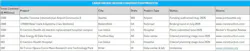
Two of the largest projects in in this region’s construction pipeline were in the transportation area, with funding authorized for the $2.5-billion Concourse S at Seattle-Tacoma International Airport in Aug. 2026 and the California High-Speed Rail Authority’s $2.4-billion high-speed rail project in Bakersfield, CA, breaking ground in July 2026. Other large projects in the region include the $1-billion El Camino Health hospital campus entering the planning stage in Los Gatos, CA, in June 2026; Stak Energy’s $500-million data center in Prudhoe Bay, AK entering the planning stage in June 2026; and the $100-million Air Force / Space Force Maui Research and Technology Park in Kīhei, HI, that’s now underway.
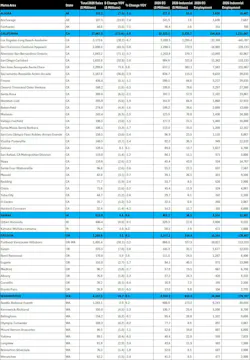
California’s estimated 2026 state-level electrical sales potential of $17.1 billion was down a point from last year, but it’s still amazing that the Golden State accounts for 10% of the U.S. total estimated electrical sales potential of $167.2 billion. The state has six Metropolitan Statistical Areas (MSAs) with an estimated $1 billion in electrical sales potential, but over that past year only the San Jose-Sunnyvale-Santa Clara, CA, MSA, showed a sizable increase in sales, with an estimated +5.8% increase to approximately $1.3 billion.
The Pacific Region’s two other billion-dollar markets, the Portland-Vancouver-Hillsboro, OR-WA, MSA, at $1.5 billion and the Seattle-Bellevue-Everett, WA, MSA at $1.3 billion were headed in slightly different directions, revenue-wise. The Portland metro was down -3.2% YOY and the Seattle market was up marginally at +0.2%.
One cause for concern in this region is the notable population declines in California’s two largest MSAs. From 2020 to 2025, U.S. Census population data shows the Los Angeles-Long Beach-Anaheim, CA, MSA, lost 338,236 residents and the San Francisco-Oakland-Fremont, CA, MSA, was down 115,812 residents. The state’s #3 MSA, San Diego-Chula Vista-Carlsbad, CA, MSA, saw a more moderate decline of 18,682 residents.
Elsewhere in this region, the Seattle metro’s population grew +3.3% during this period for a 134,069 increase to roughly 4 million residents, and the Portland metro’s population was up +1% to 2.5 million.