Electrical Wholesaling's 2027 Market Planning Guide

We are at an interesting economic juncture in the electrical wholesaling industry right now. Data center demand for electrical construction materials is pumping millions of dollars of revenues into the market. Mega-projects, each worth at least $1 billion in total construction value have never been more numerous. And despite getting punched around by tariffs, inflation, higher fuel prices and the war in Iran, the overall U.S. economy has proven to be surprisingly resilient.
It’s all enough to make one giddy, or to at least pencil in a 2027 strategic marketing plan that boils down to, as they say on Bourbon Street in New Orleans, LA, during Mardi Gras:
“Laissez les bons temps rouler ” -- Let the good times roll
Let’s stop right there. The good times may roll for your company if your business is capitalizing on the data center and mega-project bonanza. But if these projects aren’t sprouting up like mushrooms after a spring rain in the local markets in which you play, your 2027 sales forecast may be very different. While data center construction is indeed spreading regionally from its historical and current strongholds in northern Virginia’s Data Center Alley, Texas and Ohio, if they aren’t a factor in your market, you may see much slower growth.
Big distributors who play in the data center game and can shift resources into active markets for these projects have some definite advantages, for sure. But companies that focus on customer niches outside of the hyper-growth data center market may be looking at lower growth in 2027, quite possibly in +4% to +6% range. On a national basis, that would push industry sales from $167 billion in 2026 to the $174 billion to $177 billion range for 2027. On the low end, that type of growth may beat inflation, and on the high end, you may see a few points of growth. All business is local, and if you are servicing the right projects in the right local market in 2027, you could easily double that growth range. Let’s look at some industry numbers to see how Electrical Wholesaling’s editors came up with this estimate.
Sales-per-employee multipliers
To establish a base market size for the electrical wholesaling industry, since the late 1970s Electrical Wholesaling has estimated potential sales-per-employee at electrical contractors and industrials, the two core customer segments that account for roughly 75% of all sales through full-line electrical distributors. To get to our total sale estimate figures, EW’s editors then add 25% on top of that estimate to cover smaller distributor end-user markets, such as utility, government, retail, etc.
We adjusted those multipliers upward in 2026 to account for higher prices to customers that were fueled by big increases in product costs, as reflected in Electrical Marketing’s Electrical Price Index, which in October was up +7.6% YOY, compared to the normal average annual increase for the EPI’s Total Index of +2.7%. We also factored in a few points of overall growth from data centers. Those multipliers are now $86,653 per electrical contractor employee and $2,915 per industrial employee.
Using these multipliers with national employment data for electrical contractors and industrials produced a rather pedestrian growth rate in 3Q 2026 of +0.9%. The most recent employment data available from the U.S. Census Bureau was for Sept. 2026, but we don’t anticipate and marked employment increases through the end of 2026.
Click on the markets of interest in the interactive map below to see EW's latest data for total electrical sales potential, as well as estimates for electrical contractor and industrial sales potential.
Quarterly electrical market business conditions survey
Distributor respondents to the quarterly survey Electrical Wholesaling has done with the Stamford, CT-based Vertical Research Partners (VRP) equity research over the past five years have also provided invaluable guidance that we now factor into our annual forecast. For the past three quarters, these distributors reports an average growth rate in sales volume of +5.7%, not counting a price increase of +3.5% year-to-date in 2026.
Nick Lipinski, a VP and equity analyst with VRP, said electrical distributor respondents in the 3Q 2026 survey remain bullish and are optimistic about 2027, despite all these macroeconomic impediments. “Inflation, interest rates, elections, wars taken together seem to be having more of a psychological impact on business confidence than generating any material disruptions to date,” he said in VRP’s most recent report. “That said, diesel prices are starting to be noticeable and may pose a bigger headwind moving forward than has currently been realized. Tariffs were hardly mentioned in our discussions with distributors. This is not to suggest they are having a benign impact, but rather that they are now sufficiently absorbed into the business process such that they are unremarkable.”
Distributor respondents to the EW/VRP survey had lots to say about data centers. “It’s impossible to escape the topic of data centers,” Lipinski said in his analysis. “Direct and indirect activity here is clearly the main driver of strength for distributors with exposure. Visible pipelines are now extending out to 2029 in some instances, and dirt has been turned on projects that extend out into the 2030s. Distributors are raising the same questions as investors around the sustainability and duration of the cycle. Several distributors pointed to some crowding out effect from DCs, not only in terms of labor and raw materials but factory capacity at the OEMs. Hyperscalers buying direct are ‘bogging down the factories,’ according to one distributor.
ConstructConnect’s Fall 2026 Construction Economy Outlook
Richard Branch, chief economist for the American Institute of Architects (AIA) and manager of the Consensus Construction Forecast says that the construction market has been underperforming since 2024, but that there is a good chance the market is at the bottom of this business cycle. During ConstructConnect’s Fall 2026 Construction Economy Outlook, he said growth in the construction industry is also being hampered by the war in Iran’s impact on oil prices, tariffs, immigration, generally soft economic conditions for the overall U.S. economy and the impact of the work-from-home trend on new office construction. “The economy is surviving but certainly not thriving,” he said during the webinar.
Another speaker at ConstructConnect’s Fall 2026 Construction Economy Outlook held Nov. 12, ConstructConnect Chief Economist Michael Guckes, said while the data center and power sectors are currently generating an investment boom unlike anything the construction industry has ever seen, on the macroeconomic level, in the near future higher interest rates will make construction projects more expensive to build. He also said that declines in the U.S. birth rate and in immigration declines will intensify worker shortages in the construction industry.
Guckes also pointed out how much the impact of mega-projects (construction jobs with a total contract value of more than $1 billion) on the construction market has grown over the past few years. He said ConstructConnect first started seeing data centers valued at $1 billion or more in 2022, but that in 2025 the largest data centers were topping $10 billion in total contract value. Guckes also said that megaprojects now account for 28% of all construction spending — a rapid increase from the 12% they represented in the pre-Covid era. While these mega-projects can be a big win for smaller electrical contractors in the local markets where they are breaking ground, it’s not uncommon for national electrical contractors with experience with mega-projects such as data centers to follow these projects anywhere in the United States and to send work crews to service these jobs.
American Institute of Architects’ (AIA)Consensus Construction Forecast
AIA’s 2026-2027 Consensus Construction Forecast echoed many of the concerns voiced at the recent ConstructConnect online foercast. Back in July 2026, it said: “The weakness in construction reflects three major influences affecting the U.S. economy: cyclical pressure, structural shifts, and policy. The cyclical pressure stems from high interest rates and persistent inflation, which have cooled consumer demand, tightened financing conditions and led to an easing in the labor market. In that environment, developers are rethinking, delaying or shelving projects.
“Meanwhile, structural shifts are reshaping the outlook across most building sectors. A rapidly aging population drives demand for health care and related institutional services, while lower immigration and slower labor force growth are adding to workforce constraints. These dynamics affect not only the cost and availability of labor but also the long-term outlook for housing and school buildings. The third influence is policy. Higher tariffs, increased immigration enforcement and rising geopolitical risk have all added uncertainty to project planning. In combination, these three forces have created a potent cocktail that will continue to weigh on material prices and building efforts.”
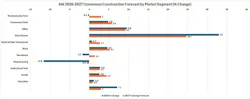
The eight construction economists who contributed to AIA’s Consensus Construction Forecast had a variety of opinions on the 2027 growth rate for the nonresidential construction market. While the overall forecast is calling for a +3% increase in the market, three participating economists had a more optimistic take on business conditions: ConstructConnect (+6.7%); Wells Fargo Securities (+4.4%); and Piedmont Crescent Capital (+4.1%). On the other side of the ledger were three economists forecasting growth more than a point below the +3% AIA consensus: Moody’s Analytics (+1.6%); Markstein Advisors (+0.3%); and Associated Builders and Contractors (+0.2%). As a group the economists see the strongest growth in data centers (+24.7%, but down from +33% in 2026); offices (+9.2%); commercial (+5.8%); and hotels (+5.2%). They weren’t as bullish on manufacturing (-0.2%); education (+0.9%); and warehouse (+1.4%).
2027 revenue forecasts by publicly-held electrical companies
We did a quick search through ChatGPT for the revenue forecasts of seven publicly held electrical manufacturers and distributors that have published 2027 revenue growth forecasts and the average growth range for these companies was bullish at +6% to +8%. These companies were Wesco, Rexel, Hubbell, Legrand, ABB, Schneider Electric and Eaton.
Other valuable leading indicators
Electrical Wholesaling’s editors also use AIA’s monthly Architecture Billings Index (ABI), which surveys member architecture firms on inquiries and billings; the Dodge Momentum Index (DMI), published monthly by Dodge Construction Network and Deltek to forecast future nonresidential construction activity; and forecasts and commentary from the National Association of Home Builders (NAHB) to get a sense of homebuilding activity.
The interactive maps below highlight two good indicators that will give you a feel for the potential growth of construction in a local market - data from the U.S. Census Bureau on population growth at the county level and building permit data at the Metropolitan Statistical Area (MSA) level. Just click on the market of interest and you will see the data in a pop-up. To download the data, click on "Get the Data" at the bottom of the map.
Using EW’s 2026 Market Planning Guide
This is the third year EW’s Market Planning Guide will be published in an all-digital format. Like last year, it uses online mapping tools to present our local, state and national market data. We still present market summaries, sales estimates and employment data by the U.S. Census Dept. regions, as we have done over the past few years, and we used EW's sales-per-employee multipliers to develop our sales estimates.
The sales potential estimates in the regional data cover all states and the largest MSAs within those regions. Access to the quarterly updates to our sales estimates for all 300-plus MSAs is available as part of a $99 annual subscription to Electrical Marketing. You can subscribe online for that data and see all the other market data available by clicking here.
Summary
Whoever first said, “May you live in interesting times,” could have very well been referring to this era in the electrical wholesaling industry. EW’s editors have never seen a certain project type of business niche dominate the industry conversation like data centers. And who could have ever forecasted the changes in the single-family and office construction markets, which at one time probably accounted for well over 20% of business to electrical distributors. These businesses have made much smaller contributors to distributor revenues in recent years.
Next year should provide decent revenue opportunities for the overall electrical market, but there are a lot of “Big Ifs” looming on the horizon. If there are any dramatic changes in inflation rate – positive or negative -- could drop right to the bottom line of distributors’ ledgers. On the world stage, if there is an end or escalation of the war in Iran, it would have a direct impact on the price of gasoline and diesel, as well as other products with a high petrochemical content. If there’s a rollback in tariffs, it would be welcome news for many in the electrical market. And if local opposition to data centers stalls future development in a big way, there could be a dramatic decrease in electrical construction materials for these projects.
Fasten your seatbelt and grab your beverage of choice. 2027 could indeed be a very interesting ride.
DON'T FORGET TO CHECK OUT THE 2027 MARKET PLANNING GUIDE'S REGIONAL FACTBOOK
Are looking for a quick, top-line analysis of what's happening in the electrical market in each of the U.S. economic regions? Electrical Wholesaling's offers a quick summary of local market electrical sales potential, construction projects of note and othe insight its Regional Factbook. To check out specific regions states and local markets of interest, click on the links below:
New England Region
Connecticut Massachusetts, Maine, New Hampshire, Rhode Island & Vermont
Middle Atlantic Region
New Jersey, New York & Pennsylvania
South Atlantic Region
East North Central Region
Illinois, Indiana, Michigan, Ohio & Wisconsin
West North Central Region
Iowa, Kansas, Minnesota, Missouri, Nebraska, North Dakota & South Dakota
East South Central Region
Alabama, Kentucky, Mississippi & Tennessee
West South Central Region
Arkansas, Louisiana, Oklahoma and Texas
Mountain Region
Arizona, Colorado, Idaho, Montana, Nevada, New Mexico, Utah & Wyoming
Pacific Region
Alaska, California, Hawaii, Oregon & Washington
About the Author
 Jim Lucy
Editor-in-Chief
Over the past 40-plus years, hundreds of Jim’s articles have been published in Electrical Wholesaling and Electrical Marketing newsletter on topics such as the impact of new competitors on the electrical market’s channels of distribution, energy-efficient lighting and renewables, and local market economics. In addition to his published work, Jim regularly gives presentations on these topics to C-suite executives, industry groups and investment analysts.
He recently launched a new subscription-based data product for Electrical Marketing that offers electrical sales potential estimates and related market data for more than 300 metropolitan areas, and in 1999 he published his first book, “The Electrical Marketer’s Survival Guide” for electrical industry executives looking for an overview of key market trends.
While managing Electrical Wholesaling’s editorial operations, Jim and the publication’s staff won several Jesse H. Neal awards for editorial excellence, the highest honor in the business press, and numerous national and regional awards from the American Society of Business Press Editors. He has a master’s degree in Communications and a bachelor’s degree in Journalism from Glassboro State College, Glassboro, N.J. (now Rowan University).